
From your phone
An agent that finishes while you are out has finished ten minutes ago by the time you sit back down. The phone view is the answer to that: every tab, what it is doing, and a box to reply in.
There are three levels to it, and you can stop at any of them.
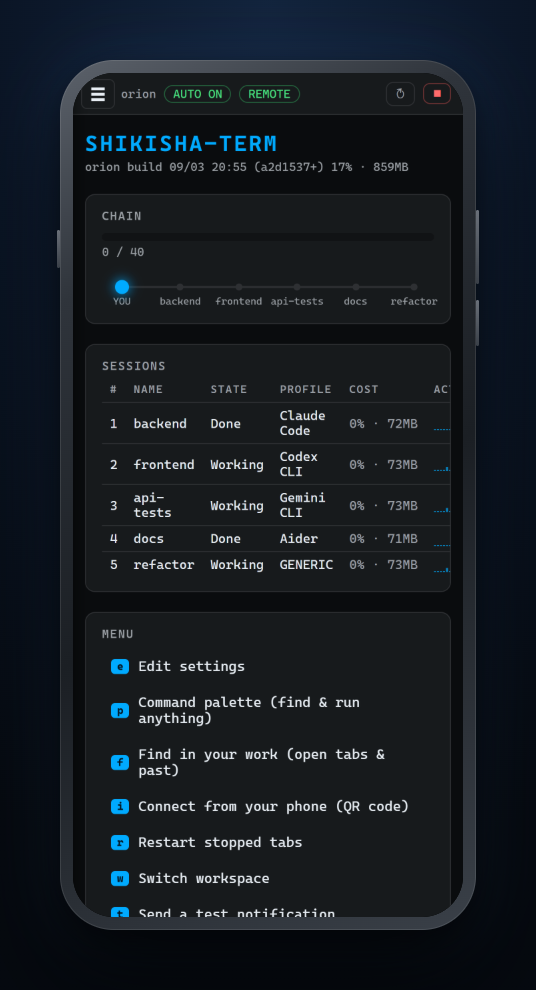
1. On the same Wi-Fi — nothing to install
Section titled “1. On the same Wi-Fi — nothing to install”Open the settings, find Phone, and turn on Let me check status and send instructions from my phone. A QR code appears. Point your phone’s camera at it.
That is the whole setup. Nothing is installed on the phone, no account is made, and nothing of yours leaves the house: the page comes from a small web server inside the program on your own PC, and your phone connects to it directly.
What you give up: it stops at the front door. Leave the Wi-Fi and the address is not reachable any more. Anyone else on that same network could reach the address too — they would still need the access code inside the QR, but the door is visible to them.
2. From anywhere — Tailscale
Section titled “2. From anywhere — Tailscale”To reach your PC from a café, something has to connect the two ends. This program will not put your machine on the public internet to do it; that is a door that stays open whether you are at it or not.
Tailscale solves it a different way. It builds a private network out of your own devices only — your PC, your phone, your laptop — and gives each one an address that exists nowhere else. Traffic is encrypted end to end and goes directly between the two devices. It is free for personal use, and it is not ours: we neither run it nor see it.
- Install it on the PC and on the phone — tailscale.com/download
- Sign in with the same account on both
- Open the settings on the PC again. The Phone card now says Tailscale (100.x.y.z) is available
- Scan the QR code as before
Nothing about this program changes. It notices the private address and offers that one instead.
3. On the home screen, and buzzing in your pocket
Section titled “3. On the home screen, and buzzing in your pocket”Two things a phone browser will only do for a page it considers secure: keep it on the home screen like an app, and deliver notifications while it is closed. “Secure” here means HTTPS, and a plain address on a private network — however private — does not count.
Tailscale can put a real certificate in front of it. One command, once, in any tab of the terminal:
tailscale serve --bg 8787(If you changed the port in the settings, use that number instead.) Restart
the program and the Phone card will say Served over HTTPS. The QR code now
carries a https://your-pc.your-tailnet.ts.net address.
Keep it on the home screen
Section titled “Keep it on the home screen”Open the board on the phone and use the browser’s Add to Home Screen. It opens without an address bar, with its own icon, like an installed app.
For that icon to be worth having, the pairing has to outlive a browser tab — otherwise it opens and asks to be paired again, which can only be done by scanning the QR, which opens the browser rather than the app. So the offer only appears with Fixed token turned on in the Phone settings.
That setting is labelled accepting the risk, and it means it: the access code stops changing and stays in that phone’s storage, so whoever holds the phone can open the board. It is the same trade as staying logged in to anything else. If that is not a trade you want, skip this step — the rest works without it.
Get notified when a tab answers
Section titled “Get notified when a tab answers”In the settings, under Notifications, add a destination and choose Phone. Then, on the phone, open the same settings page and press Register this device. The browser will ask for permission; say yes.
Then set any tab to notify when it answers. What arrives is the tab’s name and the first line of what it said — and tapping it opens a small page with that answer and a box to reply in, so “yes, go ahead” does not mean walking back to the PC.
On Android and on a desktop, notifications do not need the fixed token; only the home-screen icon does.
On iPhone and iPad it is the other way round. Apple delivers web notifications only to something that has been added to the home screen — in a Safari tab the machinery is not there at all. So on an iPhone the step above is the prerequisite for this one, fixed token included. Add it to the home screen, open it from that icon, and press the button there.
The message is encrypted for that phone before it leaves your machine. It goes through your browser vendor’s push service, which can carry it and cannot read it. There is no account of ours in the middle, because there is no server of ours at all.
What this does not do
Section titled “What this does not do”- Your PC has to be running. All of this is a web server inside the program. Nothing is queued for a machine that is off, and nothing of yours is stored anywhere else to be delivered later.
- We see none of it. Read the privacy policy — the short version is that there is nothing for us to see.