

Agents that hand off work
A code-and-review loop that runs until it passes, then messages you on Slack. The limit on how many times work may pass along is yours to set.

Works with Claude Code, Codex, local LLMs and more. Drive it from your PC or your phone, run agents in several worktrees at once, on this machine or on a cloud VM, and move your work forward in parallel.
* Using it from a phone requires Tailscale (free).
* E2B is supported as a cloud runtime.
Works with Claude Code · Codex · Gemini · Aider · Ollama · DeepSeek · Qwen — or any shell over SSH
Running one terminal AI is easy. Running four is not.
You end up with a window per agent, a lot of alt-tabbing to find the one that stopped, and a lot of copy-pasting between them. The agent that finished ten minutes ago sits there finished, and you find out when you happen to look.
SHIKISHA-TERM reads the screen and tells you. Every tab says whether it is working, done, or waiting for you — read from what the tool actually printed, so it works with any CLI rather than one vendor’s API.
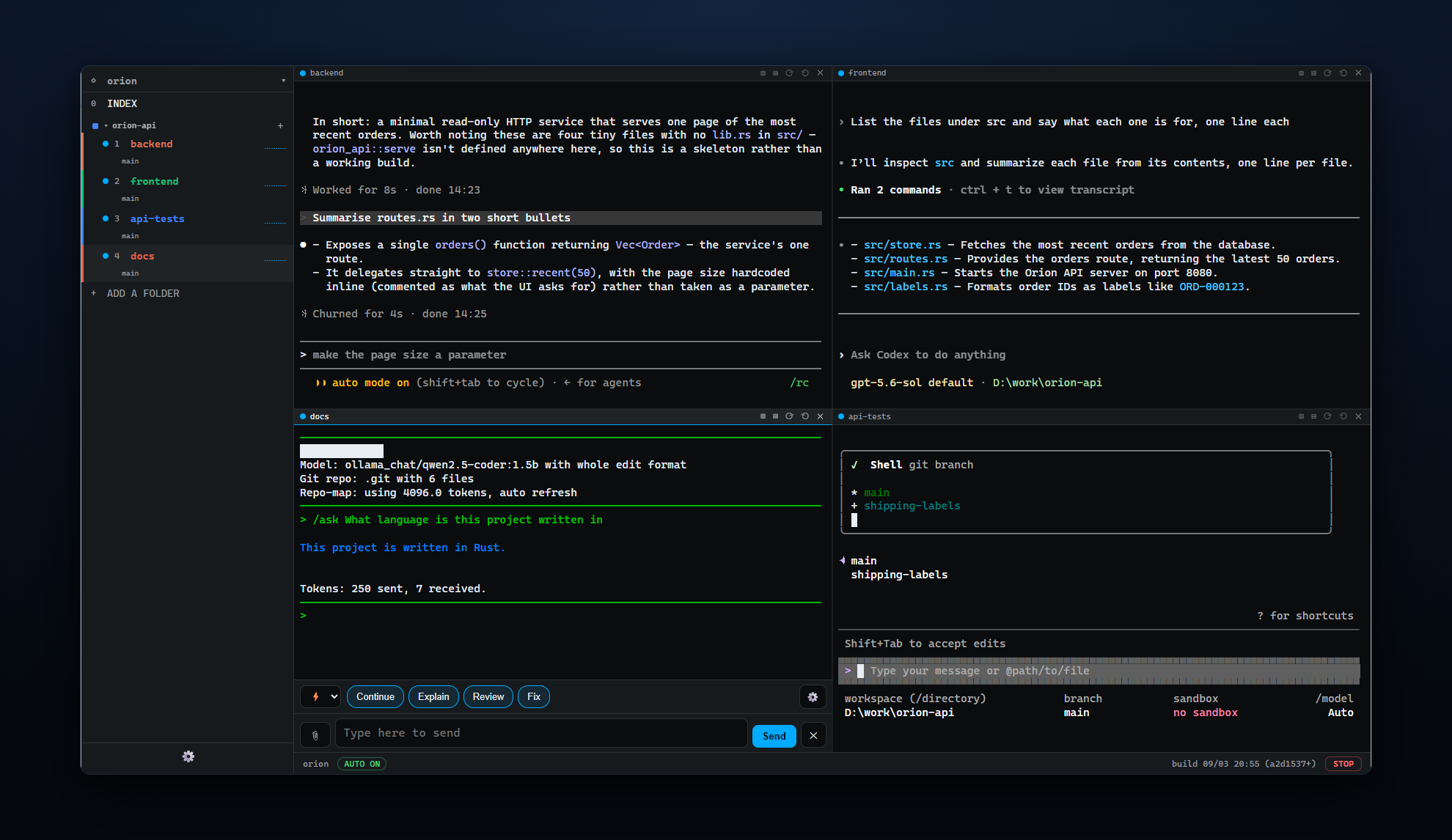
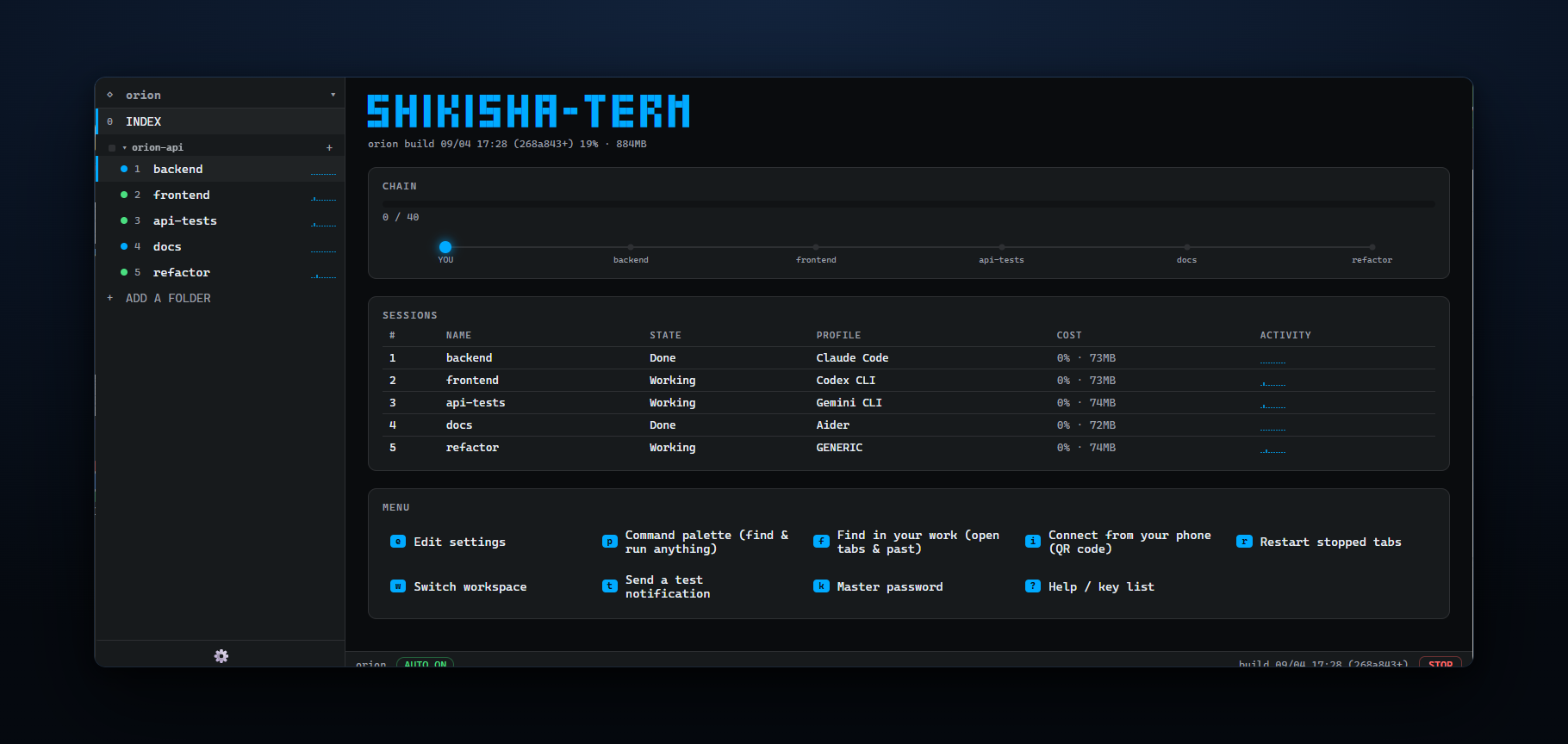
Ctrl+B 0 turns the same four into a list: what each one is costing the machine, and how
long it has been quiet.
Knowing who is waiting is half of it. The other half is not being the courier.
Say it once — when this one finishes, send the result to the review tab — and it happens without you. Write it in Lua, or describe it in plain language and let an AI you already have installed write it for you.
Agents that hand off work
A code-and-review loop that runs until it passes, then messages you on Slack. The limit on how many times work may pass along is yours to set.
Put them in a room together
Have Claude, Codex, Gemini and DeepSeek debate a question, with a judge to sum it up. The whole exchange becomes a readable transcript you can keep.
Brakes that hold
An emergency stop, per-tab input locks, a cap on chained hand-offs, and automation that gets no file or network access unless you grant it.
A real terminal
SSH, Docker, WSL, jump hosts, key files, port forwarding, session logs, legacy encodings, IME input and the mouse. Not a wrapper around one tool.
An agent that does not know where it is will happily edit the wrong project.
Tabs are grouped by the working folder they run in, and the settings screen will cut a git worktree so that a branch gets a folder of its own. Two agents on two branches then stop editing one checkout out from under each other, and each keeps its own session history where its work is. A tab whose folder is not on this machine says so and stops, rather than quietly opening somewhere else.
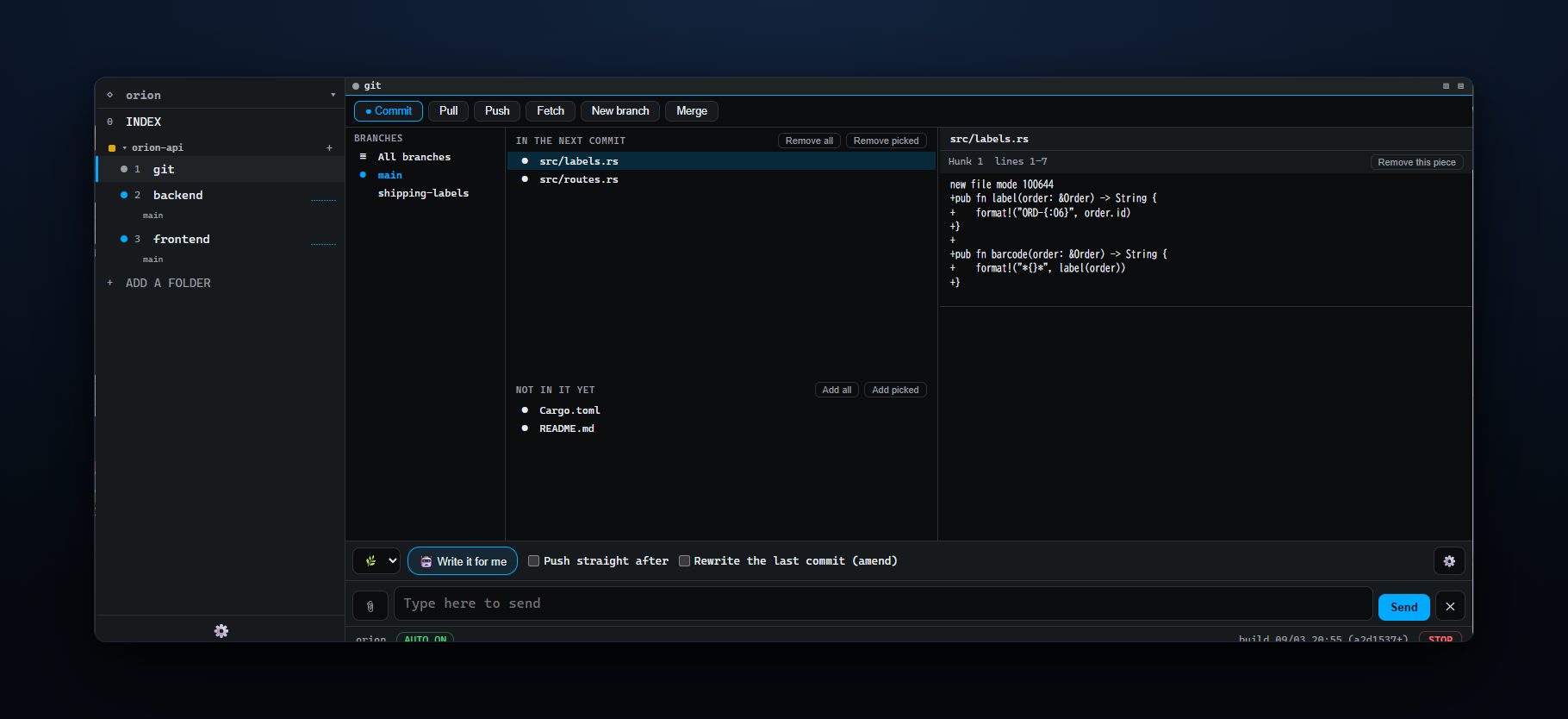
A git panel opens where a terminal would: stage a piece of a file rather than the whole file, read the history from the same panel, write the commit message yourself or have it written for you, and settle a merge with an AI untangling it while you decide.
Scan a QR code and you can see what every tab is doing and send instructions — from the train, from a café, from bed. Over Tailscale only your own devices can reach it, encrypted, from anywhere.
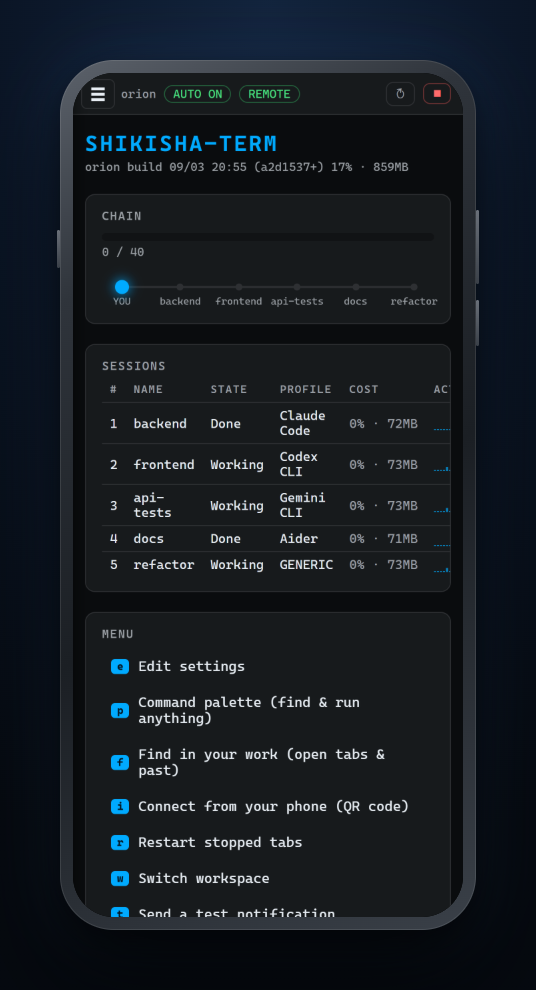
How to set it up — on your own Wi-Fi there is nothing to install.
[e]. The settings screen opens inside the window, and you pick which AI runs
in which folder. No JSON to edit.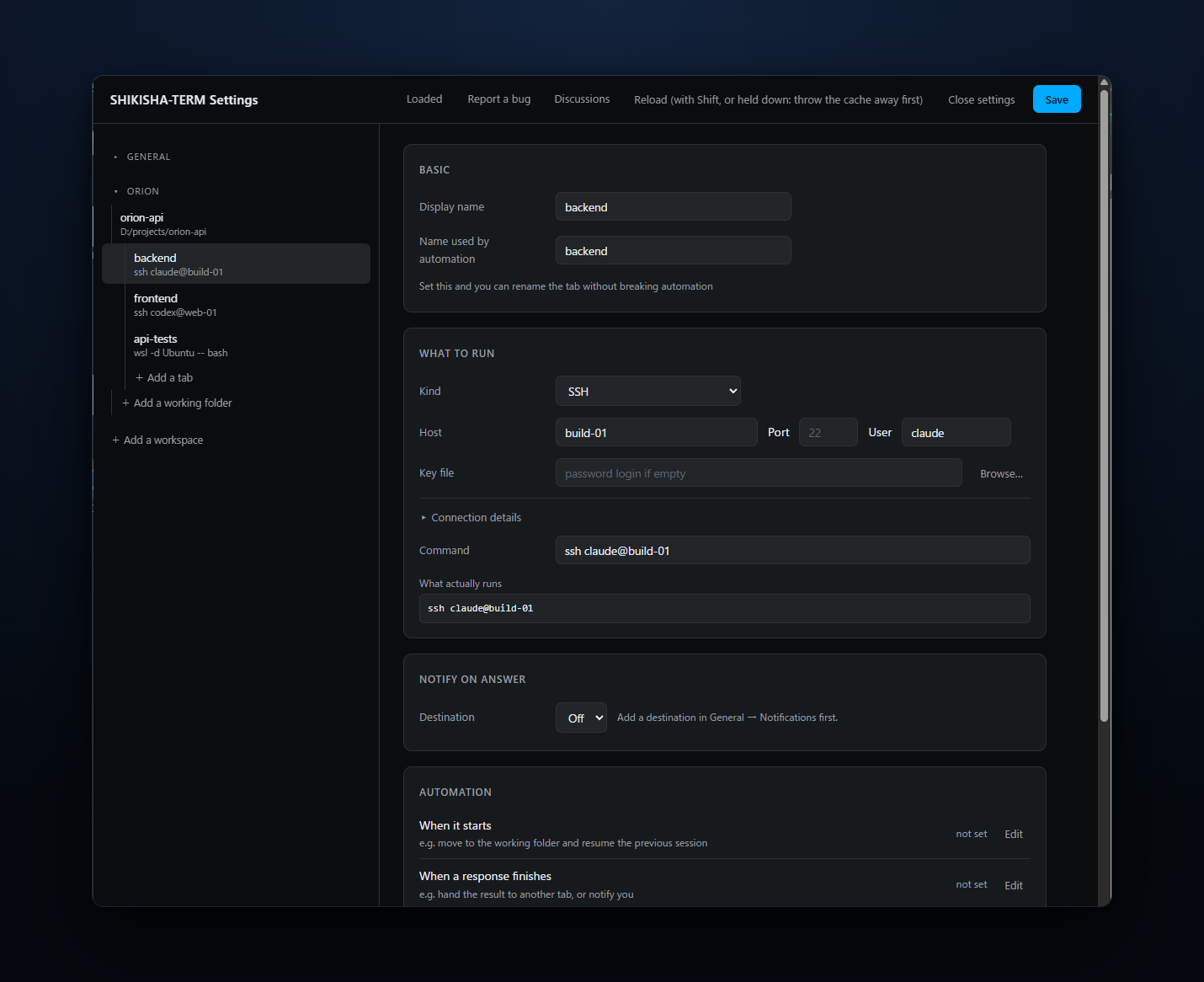
No. It drives the command-line tools you have already installed and signed in to, using the subscriptions you already pay for. It stores no keys and asks for none.
No — it runs them. Your logins, settings and history stay exactly where they are. If a new CLI comes out tomorrow, point a tab at it.
Today, yes. It is built on ConPTY, the Windows pseudo-console, rather than on a cross-platform shim — which is also why SSH, WSL, IME input and legacy encodings behave the way they do on Windows.
By default, nothing. There is no account and no server of ours. Connections happen only where you set them up, and go straight to the party you chose: the AI provider whose key you entered, a webhook you registered, or your own phone. The privacy policy lists every one of them.
A terminal. It has a git panel and a browser because agents need them, but it is not trying to become your editor.
The Store copy is signed by Microsoft, shows no warning and updates itself. The zip is the same build with nothing installed — unzip it, run it, delete the folder to remove it — but Windows will warn about it the first time, because it is not code-signed. See below for what that looks like and how it goes away.
The first time you run the unzipped copy, Windows says “Windows protected your PC”. That is SmartScreen, and it is alarming if nobody warned you — so, warning you: it is expected, and More info → Run anyway gets past it. It appears because the zip carries no code-signing certificate, not because anything is wrong with the file. Every release is built by public GitHub Actions from a tagged commit, and a SHA256 sits next to the download so you can check the bytes you got are the bytes that were built.
The Store copy does not show it at all — Microsoft signs that one.
Making it disappear from the zip too means a code-signing certificate. SignPath Foundation issues them to open source projects for free, and for programs like this one they ask for “a certain verifiable reputation” before putting their own name behind a certificate. For a project on GitHub, the most legible form that reputation takes is stars.
So if this is useful to you: star it on GitHub. It is the one thing a stranger can do in a second that makes a signed build likelier — for everyone who downloads the zip after you.